
Carbon
Get the font
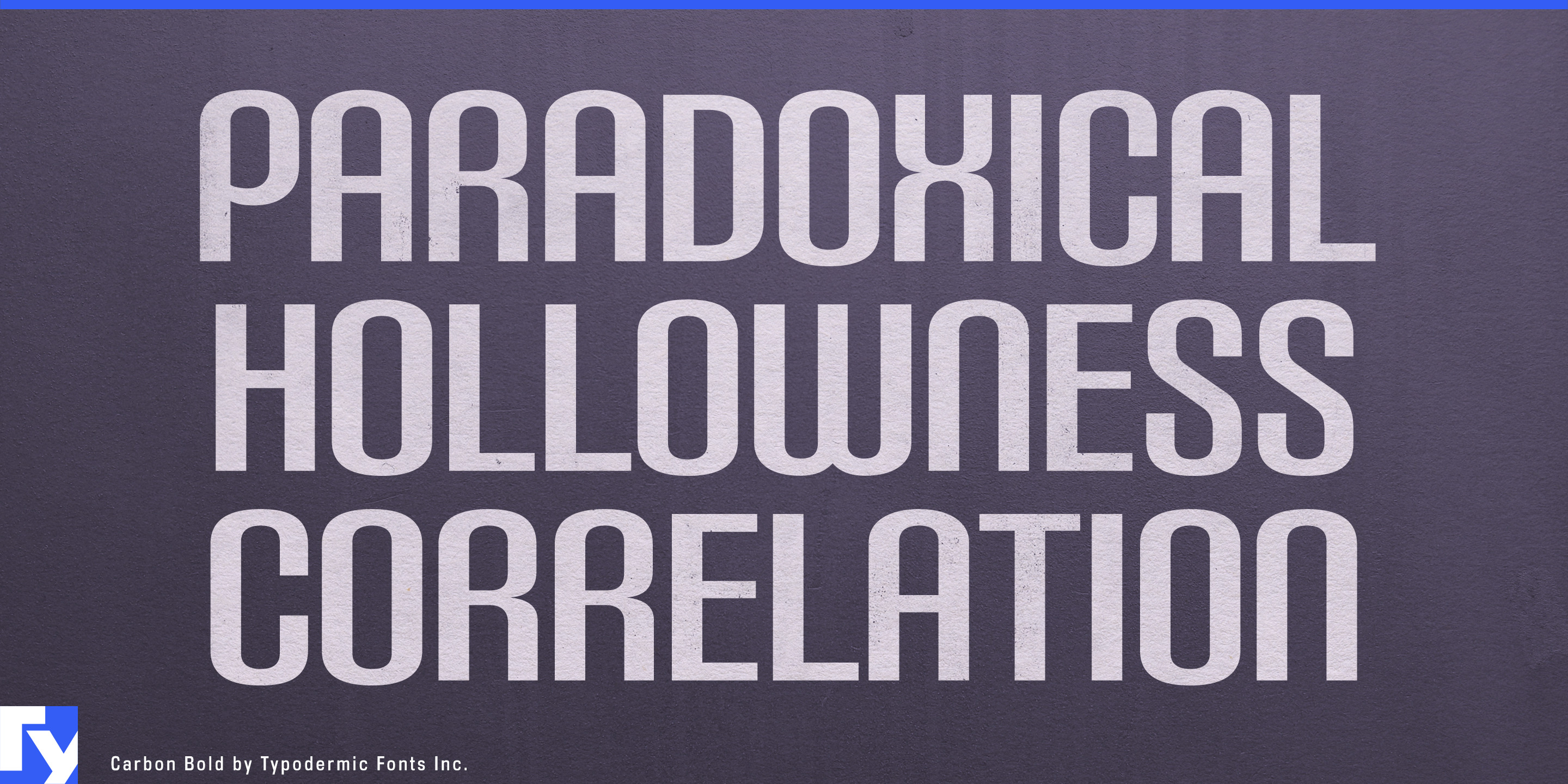


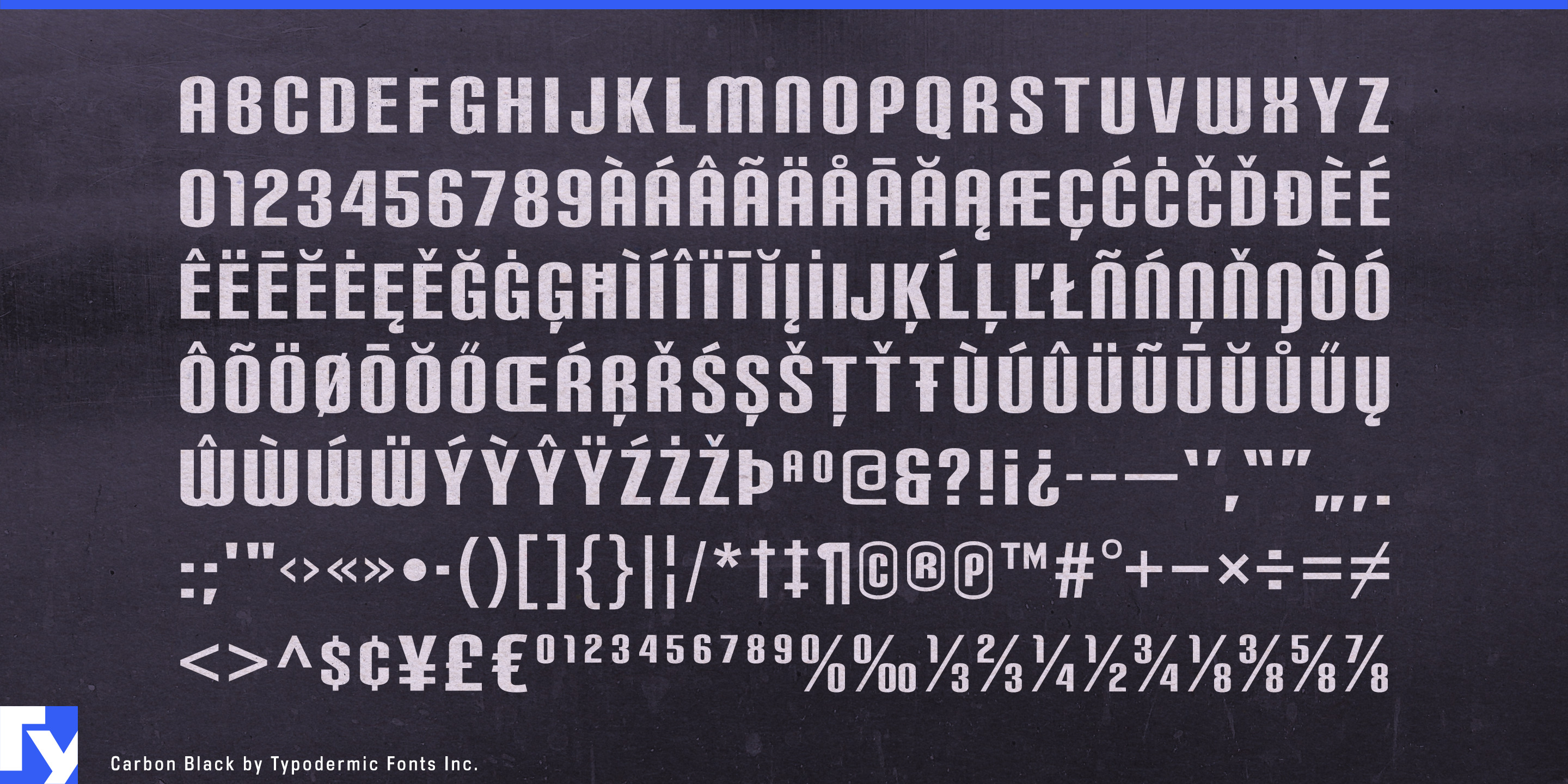


Technical products often end up wearing one of two typographic uniforms: neutral corporate sans serifs that say little about the product, or aggressive futuristic lettering that dates as quickly as the technology. Carbon takes a more structural approach. Its letters look assembled from a controlled set of geometric parts, giving technical typography a recognizable system without turning every word into science fiction.
The recurring element is an elongated capsule, a flat-sided rounded form that reappears throughout the alphabet wherever the construction allows it. Combined with Carbon’s unicase forms, this creates an unusually consistent vertical rhythm. At lighter weights the structure becomes fine and diagrammatic; at the heavy end, the same modules turn into dense slots and pillars. The result feels manufactured rather than decorated.
That makes Carbon especially well suited to advanced materials. Carbon-fiber bicycle frames, aero wheelsets, composite body panels, performance helmets, racing seats, lightweight robotics components, engineered polymers, ceramics, and coatings all need typography for model names, component graphics, technical brochures, specification cards, and trade-show displays. Carbon’s systematic construction suits products whose own performance depends on controlled material structure.
Performance cycling provides a particularly natural application. Frame names, fork graphics, rim decals, helmet ranges, power meters, component series, geometry charts, and launch campaigns all have to work across narrow, curved, and highly visible surfaces. Carbon can provide delicate technical information in its lighter styles and substantial product names in its heavier ones without resorting to the usual slanted racing typography. Carbon Phyber can be introduced selectively when a woven-composite association is useful.
Battery technology and electrification extend the same idea into graphite processing, conductive materials, electrode systems, cell manufacturing, battery recycling, and energy-storage research. Carbon can carry technology names, research-report titles, factory graphics, conference displays, and technical diagrams while retaining a direct connection to engineered structure.
The lighter weights also suit scientific instrumentation: materials-testing systems, spectroscopy equipment, environmental sensors, imaging hardware, and laboratory automation. Model names, fascia graphics, diagrams, and conference material can use the repeated rounded modules almost like a visual notation system.
Carbon’s name also gives it a literal contemporary role around carbon capture, emissions monitoring, low-carbon manufacturing, carbon accounting, and industrial decarbonization. It does not claim environmental virtue; it simply gives these subjects a distinctive display vocabulary.
Carbon works best where technology is physical: a laminate, frame, cell, sensor, instrument, component, or industrial process. Its letters look as though they were built from a repeatable set of parts, allowing the family to move naturally between advanced materials, performance equipment, laboratory hardware, and emerging energy systems.
Get Carbon
Desktop licenses cover print, logos, and static graphics. MyFonts also offers embedding licenses for websites, e-books, and applications. Embedding licenses
Commercial font facts
Family details
- First released
- 1999
- Styles
- 16 styles
- Version
- 4.100
- Formats
- OTF
- Class
- Sans serif
- Form
- Geometric, Rounded, Modular
- Case
- Unicase
- Scripts
- Latin
- Role
- Dual purpose
Commercial style names (16)
- Hairline
- Hairline Italic
- Thin
- Thin Italic
- Extra-Light
- Extra-Light Italic
- Light
- Light Italic
- Regular
- Italic
- Bold
- Bold Italic
- Black
- Black Italic
- Fence
- Phyber