
Vinque
Get the font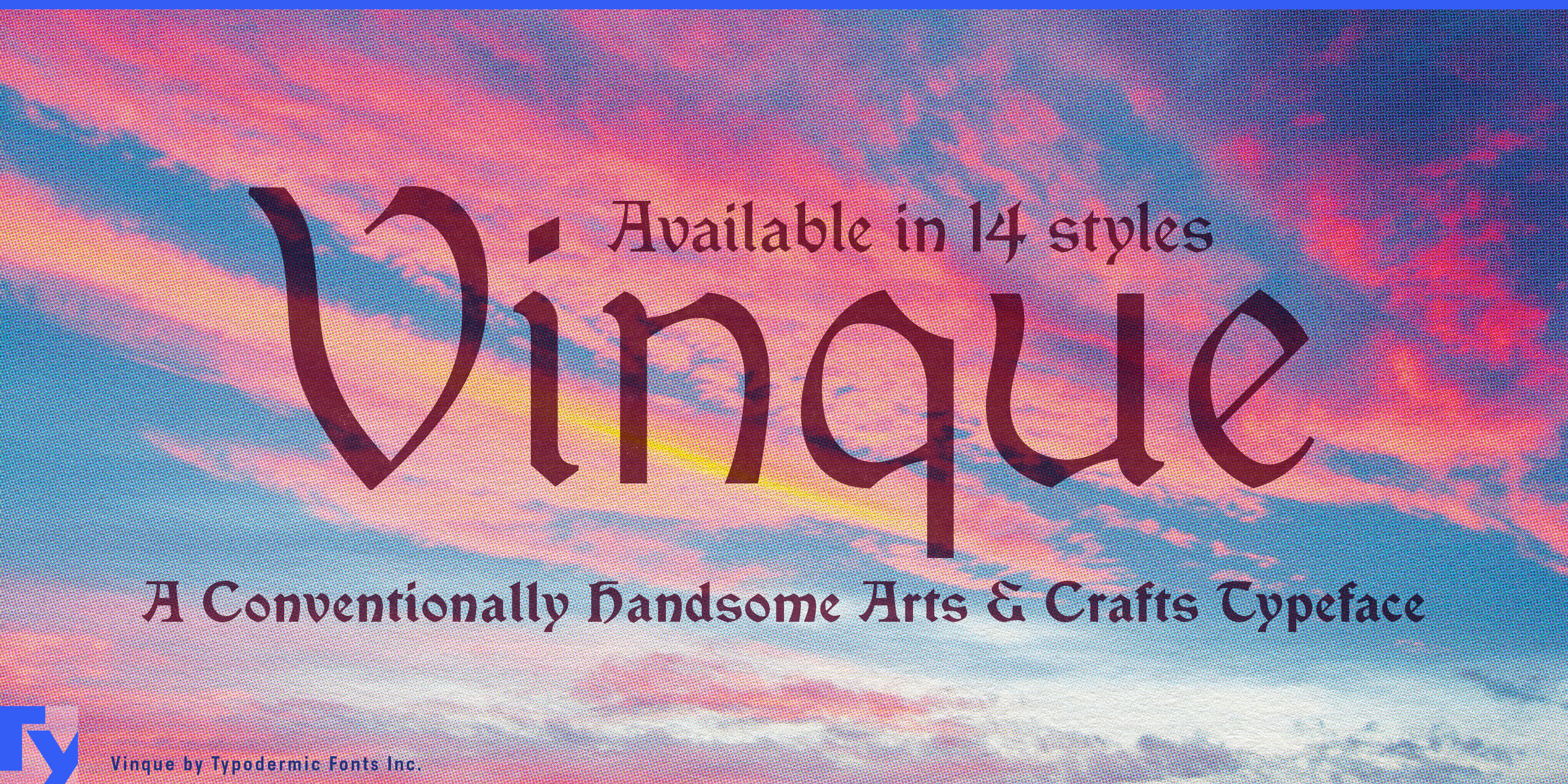


A fantasy interface has to do two things at once: establish the world and let players read it. Traditional blackletter can supply medieval atmosphere immediately, but ornate forms become cumbersome when they have to carry quest names, inventory categories, dialogue choices, location labels, and hundreds of other pieces of changing text. Vinque was designed for that middle ground. Its gothic and Arts & Crafts influences give it a historical-fantasy character while its comparatively simple letterforms remain practical for repeated display use.
That makes Vinque particularly useful in fantasy RPGs, where typography extends far beyond the title screen. Quest headings, character classes, skill trees, weapon and armor names, map locations, achievements, dialogue choices, chapter screens, and loading-screen titles all need to belong to the same world. Because much of this material changes dynamically or arrives through localization, it cannot depend on individually drawn lettering. Vinque supplies a consistent fantasy voice that keeps working as the content changes.
Medieval strategy and settlement games create the same problem at greater scale. Kingdom builders, dynastic strategy games, castle-management systems, trade simulations, and historical city builders may need province names, building categories, unit classes, resources, diplomacy headings, event titles, and campaign-map labels across thousands of interface states.
Its character also works beyond grim medieval worlds. Enchanted forests, alchemy shops, magical academies, guilds, wandering adventurers, witches, folklore creatures, and fairy-tale settings can use Vinque without acquiring the severity of traditional gothic lettering. A cozy fantasy game can use it for potion names, recipe headings, shop categories, customer requests, and chapter titles just as naturally as a dungeon game can use it for boss names, loot tiers, weapon classes, and victory screens.
The same advantages extend beyond video games. Tabletop RPG systems can use Vinque across rulebooks, campaign guides, card decks, maps, boxed sets, and digital companions. Fantasy entertainment properties can carry it through location cards, collector packaging, companion publications, merchandise, and convention environments, while immersive attractions can use it for realm names, maps, shop and tavern signs, attraction headings, and environmental graphics.
Vinque gives fantasy typography enough historical flavor to establish a setting without making the audience work for every word. It is especially useful when medieval or folkloric atmosphere has to survive not just in a logo, but across the changing names, categories, choices, and places that make a fictional world function.
Get Vinque
Desktop licenses cover print, logos, and static graphics. MyFonts also offers embedding licenses for websites, e-books, and applications. Embedding licenses
Commercial font facts
Family details
- First released
- 2001
- Styles
- 14 styles
- Version
- 5.100
- Formats
- OTF
- Class
- Blackletter
- Form
- Calligraphic
- Scripts
- Latin, Greek, Cyrillic
- Role
- Display
- Features
- Ligatures
Commercial style names (14)
- Hairline
- Hairline Italic
- Thin
- Thin Italic
- Extra-Light
- Extra-Light Italic
- Light
- Light Italic
- Regular
- Italic
- Semi-Bold
- Semi-Bold Italic
- Bold
- Bold Italic